
1 July — 15 August 2026 · done-for-you programme
Most gifting case studies are a story with three numbers bolted on. This one is the opposite. Below is the actual operating method behind a done-for-you seeding programme — how creators are found, how they are scored, what it costs to reach them, who says no and why — and then the numbers that method produced on one real Shopify store.
The store is Dr Water, a hydrogen water bottle brand. In July it handed sourcing, outreach and reply handling to the Seed team. The brand kept the one decision that matters: who gets a parcel.
Where these numbers come from
The detailed walkthrough below is a count taken from the Dr Water account on 15 August 2026, not an estimate and not a projection. The account's total has grown since. The headline numbers above (228 orders, 91.3% approved, 199 of 218) are a fresh pull from 2026-09-24, not this audit window. Where a number cannot be counted — how many profiles were read on Instagram, how many creators posted — it is either left out or marked as uncounted. Screenshots are older than the totals, so the numbers in them are lower.
The funnel, 1 July to 15 August
46 days. One product line in rotation. Two live campaigns carrying almost all of the volume, split by month so a month stays filterable afterwards.
| Gift requests submitted through the approval gate | 146 | |
| Approved by the brand | 134 | 92% of requests |
| Declined by the brand | 8 | |
| Still awaiting a decision on 15 Aug | 4 | |
| $0 Shopify orders created | 138 | 134 approved + 4 on older ungated campaigns |
| Distinct creators | 138 | nobody gifted twice |
| Shipped | 109 | median 2.5 days after approval |
| Delivered | 82 | median 1.5 days in transit |
| Still in flight on 15 Aug | 29 |
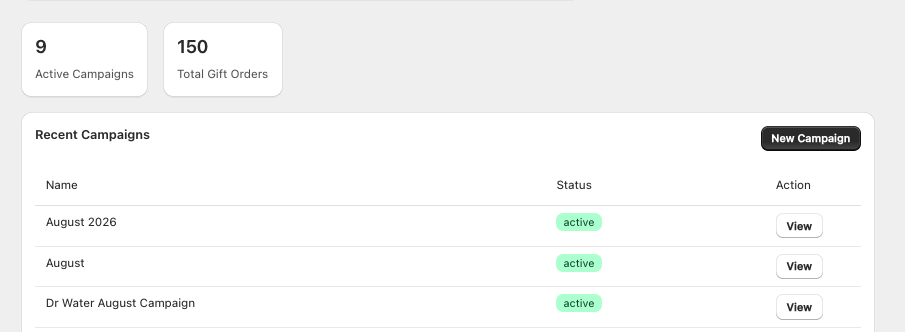
The account has now taken 228 gift orders since it started in May (pulled 2026-09-24). What follows is how the original 1 July to 15 August audit window broke down, row by row.
Step 1 — Sourcing: where the names come from
Most brands treat sourcing as one action: search a hashtag, save some profiles. At volume it is six separate surfaces, each of which finds a creator the others miss.
- Meta creator marketplace — filters do the first cut: category, so the feed matches the product rather than the follower count, and audience located where the brand actually ships.
- Instagram itself — search, geography, and the follow graph around creators who already fit.
- Competitor comment and review walls — people who already care about this category, and have already proved it in public.
- YouTube — slower to post, but a channel is a stable, contactable identity in a way an Instagram account often is not.
- TikTok, recovered through YouTube — a TikTok creator with no contact route is matched to their own YouTube channel, which usually has one.
- The brand's own customers — people already buying who already post. The cheapest list in the building, and the one nearly everyone forgets.
Every name is checked against everyone the brand has already gifted before it enters the list. Across 138 gifts in this window, 138 different creators received one. Nobody was asked twice, and no parcel went out on a duplicate.
Uncounted: how many profiles were opened and rejected on Instagram to build these lists. That work happens inside Instagram, so it is not machine-counted, and no number for it is claimed here.
Step 2 — Vetting: the score, published in full
This is the question every brand asks and almost no agency answers. Here is the whole thing. Each creator is scored out of 100 before anyone is contacted.
| Signal | Max | How it scores |
|---|---|---|
| Engagement rate | 30 | 6%+ takes all 30. 3–6% takes 22. 1.5–3% takes 14. Below that, 6. |
| Audience size | 25 | 5k–200k followers takes all 25. 200k–1M takes 15. 1k–5k takes 12. |
| Posting cadence | 20 | Posts every 7 days or better takes 20. Every fortnight, 14. Monthly, 8. |
| Niche match | 15 | All 15 if the creator's tags match what the brand sells. |
| Contactability | 10 | A working contact route takes 10. None is a hard reject. |
65 and above is an accept. 40 to 64 is a backup, used when a list runs thin. Below 40 is a reject. No contact route is an automatic reject whatever the rest of the score says, because a creator who cannot be reached is not a creator, it is a screenshot.
Three of those weightings are worth defending, because they are where brands go wrong.
- Engagement outranks reach. A 6,000-follower account at 6% engagement beats a 40,000-follower account at 0.4%, and the parcel costs the same either way. The second one looks better in a spreadsheet and performs worse in every other respect.
- Over a million followers scores lower, not higher. Those creators expect a cash fee, convert far worse on a gift alone, and consume the same operational time as five micro creators who will actually post.
- Cadence is worth 20 points on its own. A dormant account never posts the gift. It is the single most common way a gifting budget disappears with nothing to show for it, and the one signal nobody checks.
Then the part no score catches, done by eye, one profile at a time:
- Has this creator posted for a brand before, and did that post look forced?
- Did they take a gift once and go quiet? That history disqualifies.
- Do the last ten posts read like someone who still enjoys this?
- Is the comment section people, or a pod trading the same four emojis?
- Would the founders want their product sitting next to this feed at all?
Every verdict is stored with its inputs — the score parts, follower count, engagement, cadence, contact status, the sample posts it was read from, and a timestamp. Months later it is still possible to answer “why did we skip her?” with a record instead of a memory. On Dr Water this checklist was run by hand by the team; the same rules now run as a scoring engine inside Seed, with the same thresholds.
Step 3 — Contact details, cheapest route first
Finding a creator is free. Reaching one is not, and this is where seeding programmes quietly become expensive. Between half and seven in ten of any creator list has no usable contact route at all. That half has to die for nothing.
So the rule is absolute: every free method is exhausted on everyone before a single paid lookup runs on anyone, and paid lookups only ever run on creators who already passed the score.
- Bio parsing — free
- Cross-platform sibling accounts, where the other profile lists what this one hides — free
- The creator's own website, crawled — free, and it lands about 28% of the time
- Link-in-bio pages, which are usually server-rendered and readable — free
- TikTok to YouTube cross-linking, which routes a dead end into a live one — free
- Only then, paid lookups, at roughly 1 to 12 cents per address actually found, and only on creators already accepted by the score
This ordering is the reason a programme can double its outreach volume without doubling its data bill, and the reason the price quoted to a brand is a flat monthly number instead of a per-seat data fee that grows every time the list does.
Step 4 — The message, and the replies nobody counts
Messages go out from the brand's own Instagram account, never from an agency handle. A DM from a brand gets read. A DM from a stranger gets archived. They go at a human pace, in daily batches, because the account is an asset and volume spikes are how accounts get restricted.
The opener has one job: not to read like a collab pitch. Instagram crops the preview, so whatever earns the open sits in the first line, and the ask is specific to that creator rather than a template with a name swapped in. Non-repliers get one follow-up several days later, and then are left alone.
Then the replies come back all day, and this is the part no case study mentions. Which one is the good one. Does it work on curly hair. Is this actually free. Can I have two. Can my sister have one. Do I have to post. Every one of those gets an answer, one at a time, in the brand's voice. That volume of small questions — not the sourcing, not the strategy — is the specific reason most in-house gifting programmes quietly stop after six weeks.
Step 5 — From yes to order, in one link
Every yes goes to one branded link. The creator picks their own product and variant from live stock, and types their own address. A $0 draft order lands in the Dr Water admin, tagged to the campaign it came from.
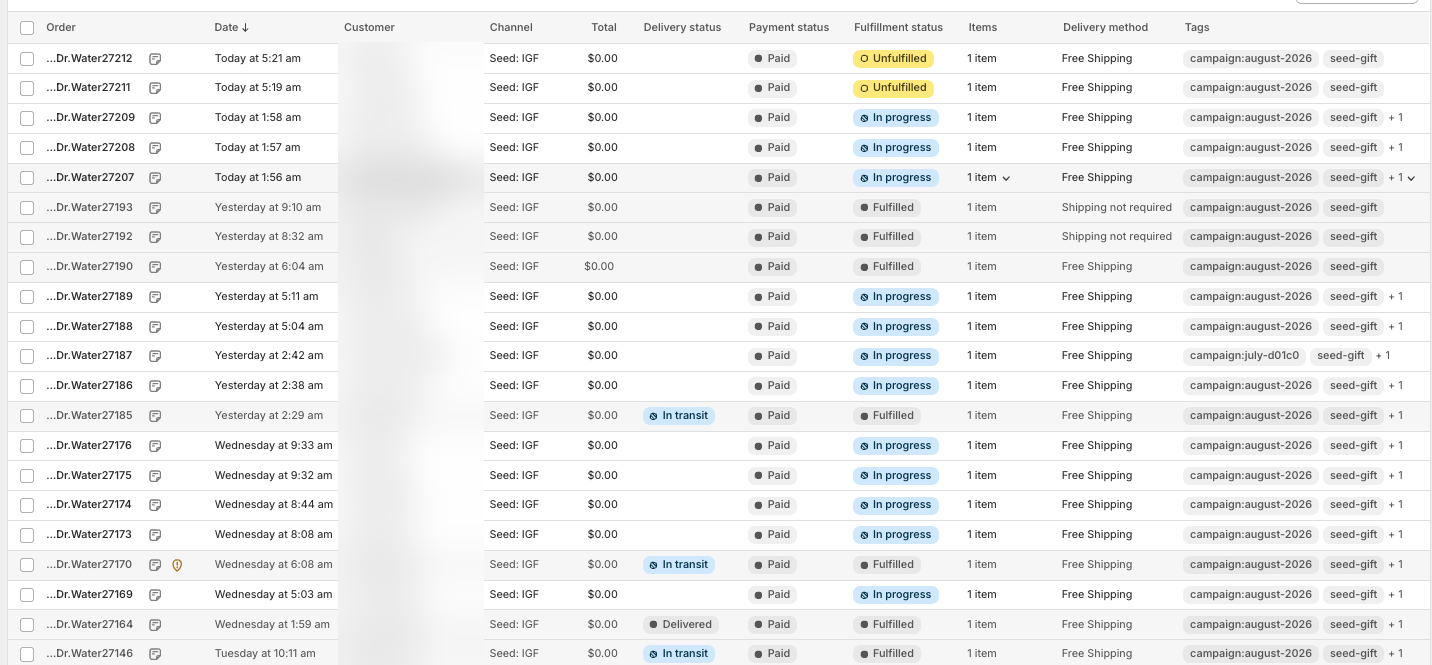
seed-gift and campaign:august-2026, so the existing fulfilment flow reads them like any other order. Creator names blurred. Older screenshot — the totals have moved since.Four things about that link are doing more work than they look like they are.
- Live stock, mirrored from the storefront. Shopify's admin will happily report a variant as available when it is only available in a warehouse the storefront cannot sell from. Reading the storefront instead is the difference between promising a colour and having to un-promise it three days later.
- The creator types their own address. No address copied out of a DM thread, no transposed house number, no reship. 127 different cities in this window, typed by 138 different people.
- The Instagram handle is captured on the form. 137 of the 138 orders carry one, which is what makes it possible later to match a post to a parcel without a spreadsheet.
- It is a real order, not a code. Codes leak, get shared, and make a gift feel like a discount. A native $0 order flows through the existing fulfilment, tracking and delivery stack with nothing to reconfigure.
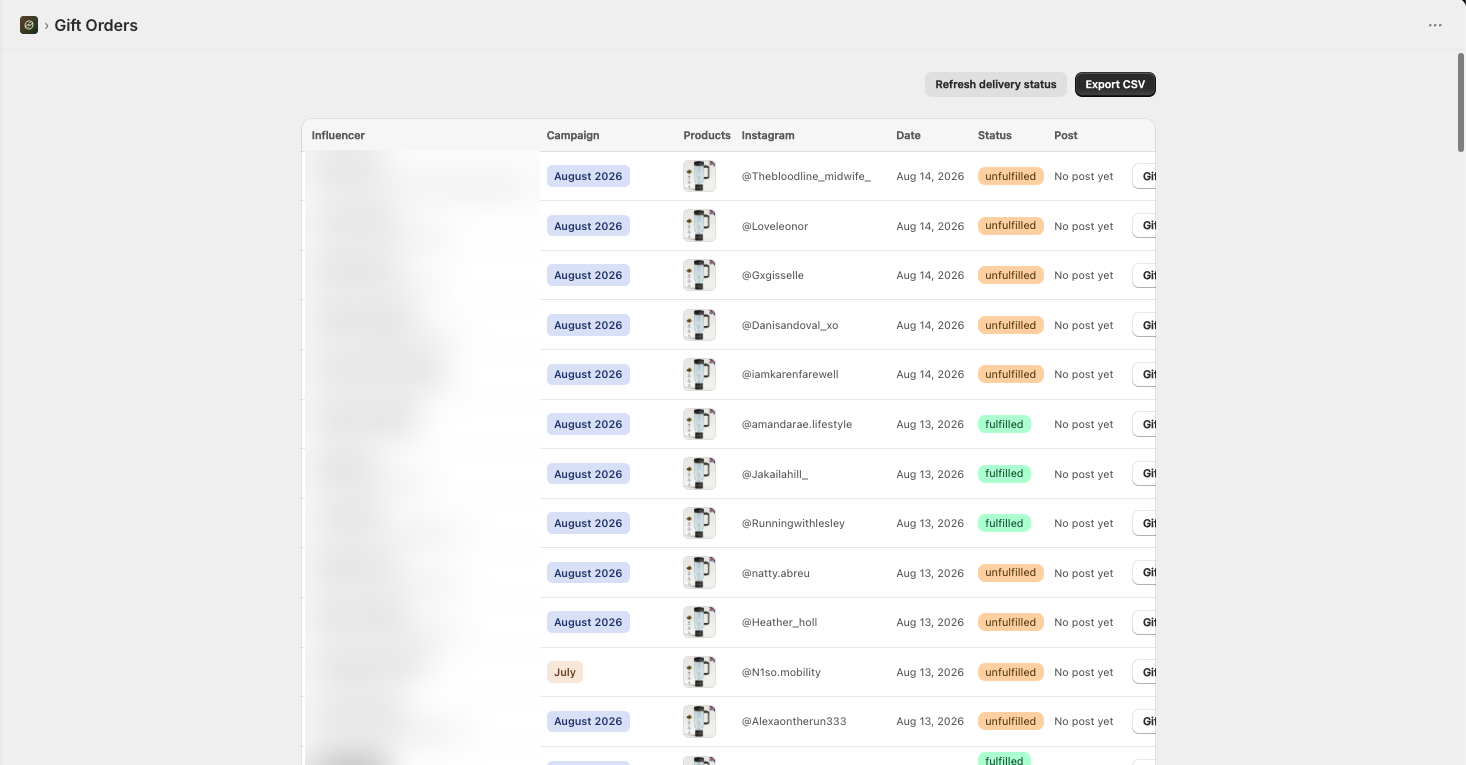
Step 6 — The approval gate, which is not decoration
Nothing ships on the agency's judgement. Every request waits in a queue until the brand approves it.
- 146 requests reached the gate between 1 July and 15 August
- 134 were approved and became $0 orders
- 8 were declined — wrong fit however good the numbers looked, stock being held back for a launch, or a feed the founders did not want their product next to
- 4 were still waiting on a decision when this page was written
The speed matters as much as the split. The median request was decided in 42 minutes, and nine in ten inside 17 hours. A gate that takes three days is not a gate, it is a queue, and creators go cold in it.
Step 7 — Ship, track, and the clock that starts on delivery
Approved orders shipped in a median of 2.5 days and spent a median of 1.5 days in transit. Shipping and delivery statuses come back into Seed on their own, which is the only reason follow-ups are possible at this volume: the follow-up clock starts when the parcel is delivered, not when it is shipped. Asking a creator about content before the box has landed is how a programme burns goodwill it spent three weeks earning.
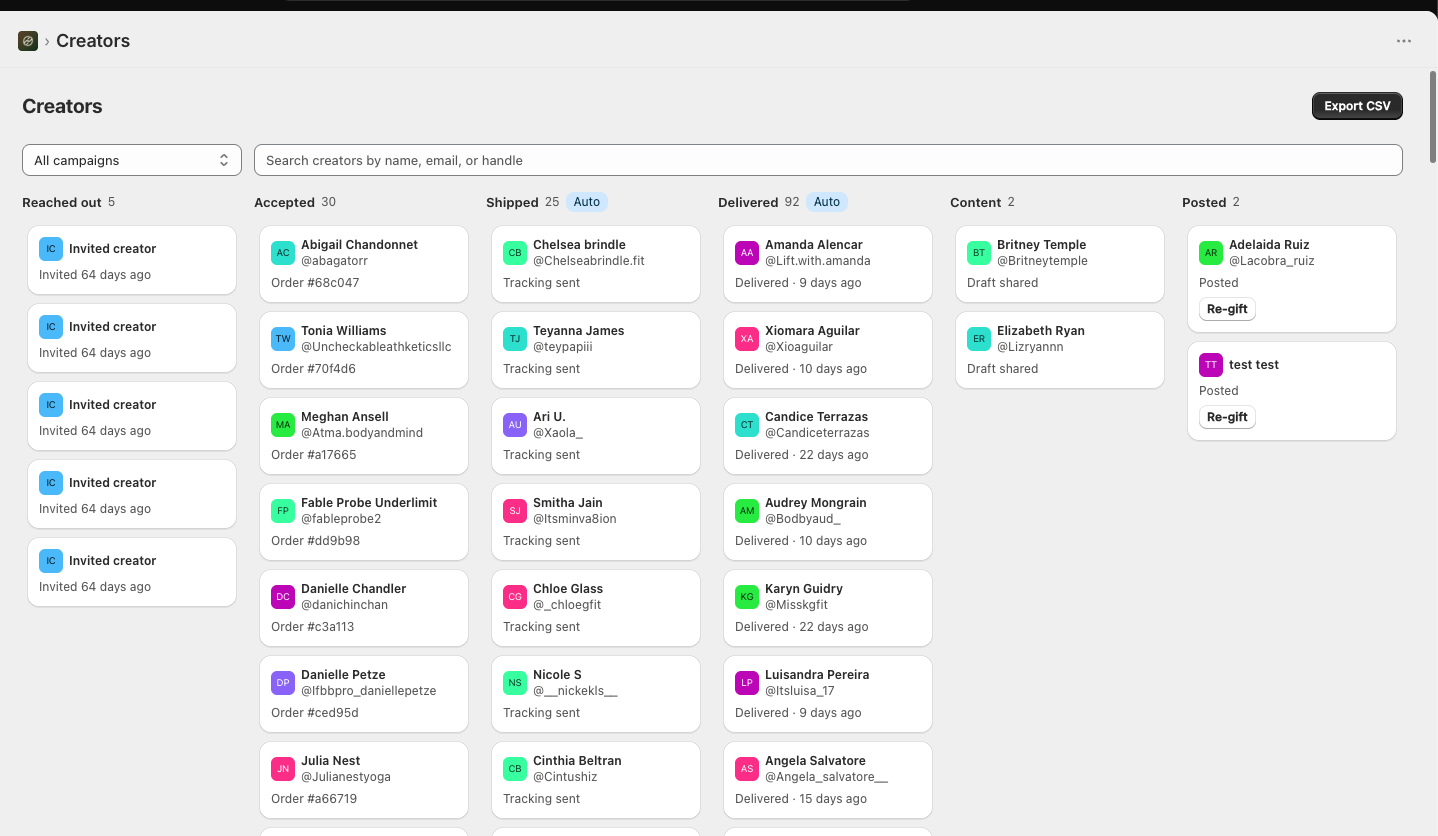
Where the whole account stood on 15 August, by stage:
- 33 ordered, waiting on fulfilment
- 25 shipped or in transit
- 98 delivered, follow-up clock running
- 4 at content or posted
What creators chose when nobody chose for them
One product, four colours, creator's pick. Across the 46 days the split came out like this:
- Black — 57
- Green — 54
- Blue — 26
- White — 0 in this window, 3 in the account's whole history
This is a small table with a large point. A brand picking on the creator's behalf in a DM thread guesses, and the guess is stock it then has to move. Green nearly matching black is not something anyone predicted, and white going untouched for six weeks is the kind of signal that only exists because 138 people were each asked.
What 46 days looked like on the calendar
Orders landed on 31 separate days, averaging 4.5 a day on days with any activity, with a peak of 9 in one day. That shape is the actual argument for handing the work over. An in-house programme runs in bursts — two good weeks, then a launch or a stockout takes over and nothing happens for a month. The only variable that moved here was how many conversations were opened each week, and it moved every week, including the bad ones.
Where the parcels went
127 distinct cities. 126 orders to the United States, 11 to Canada, 1 to India. No creator received two. For an ops team, that is the real difference between seeding and a giveaway: 138 individual addresses, each typed by its own recipient, each landing in the same admin as every paying customer.
What the brand actually did
Approve the requests. Ship them. Read the update in Slack. That is the whole list. The sourcing, the scoring, the contact hunting, the messages, the all-day replies and the follow-ups on everyone who received a parcel happened without a founder opening Instagram. The one thing the brand never handed over was the decision, and the median decision took 42 minutes.
What is not being claimed here
Whether a creator posts is still the creator's decision. Gifting does not come with guaranteed posts, and anyone quoting that number as a promise is guessing.
Post capture is also the weakest number in this system, and it would be easy to dress up. It is not: only 4 posts are recorded against these orders in the data, because a post is only recorded when a creator submits the link or the team pastes it in, and at this volume that lags badly behind reality. So no post rate is published on this page. When a number cannot be counted honestly, it does not go on the wall.
What was committed to, and what happened, is the part that can be controlled: creators found, scored, contacted, followed up, approved by the brand, and product in hand — 138 times in 46 days, whether or not the week went badly.
Questions brands ask before they start
How do you vet an influencer?
Every creator is scored out of 100 before anyone is contacted: engagement 30 points, audience size 25, posting cadence 20, niche match 15, contactability 10. 65 and above is an accept, 40 to 64 is a backup, below 40 is a reject, and no contact route is an automatic reject at any score. After the score, a human reads the last ten posts, the comment section and any past brand posts.
Why does engagement outrank follower count?
Because a 6,000-follower account at 6% engagement produces more watched content than a 40,000-follower account at 0.4%, and costs the same parcel. Accounts between 5,000 and 200,000 followers score full marks. Above a million actually scores lower, because those creators expect a cash fee and convert worse on gifting.
Does the brand still control who gets a gift?
Yes. Every request lands in an approval queue before any order exists. On Dr Water, as of 2026-09-24, 218 requests have reached a decision: 199 approved (91.3%) and 19 declined. The median decision took 40 minutes.
Is a gift a discount code?
No. Each approved request becomes a real $0 Shopify order in the brand's own admin, tagged to its campaign. Codes leak, get shared and make a gift look like a coupon. A native order flows through the existing fulfilment, tracking and delivery stack unchanged.
Do you guarantee that creators post?
No, and neither can anyone else. Whether a creator posts is the creator's decision. What is committed is the part that can be controlled: creators found, vetted, contacted, followed up, approved by the brand, and product in hand, every month.
How fast does a gift reach the creator?
On Dr Water, the median approved order shipped in 2.5 days and spent 1.5 days in transit. 109 of the 138 orders had shipped and 82 had been delivered by 15 August, with the rest still in flight.